Jamonera
105 S 13th St, Philadelphia, PA 19107 (215) 922-6061 jamonerarestaurant.com/
Marcie Turney & Valerie Safran's Spanish wine bar on 13th Street in Center City, Philadelphia.
I wouldn't normally start the review with a picture of the door panel, but I loved the metal stenciling so much I couldn't resist. Now below, the de rigueur restaurant exterior shot.
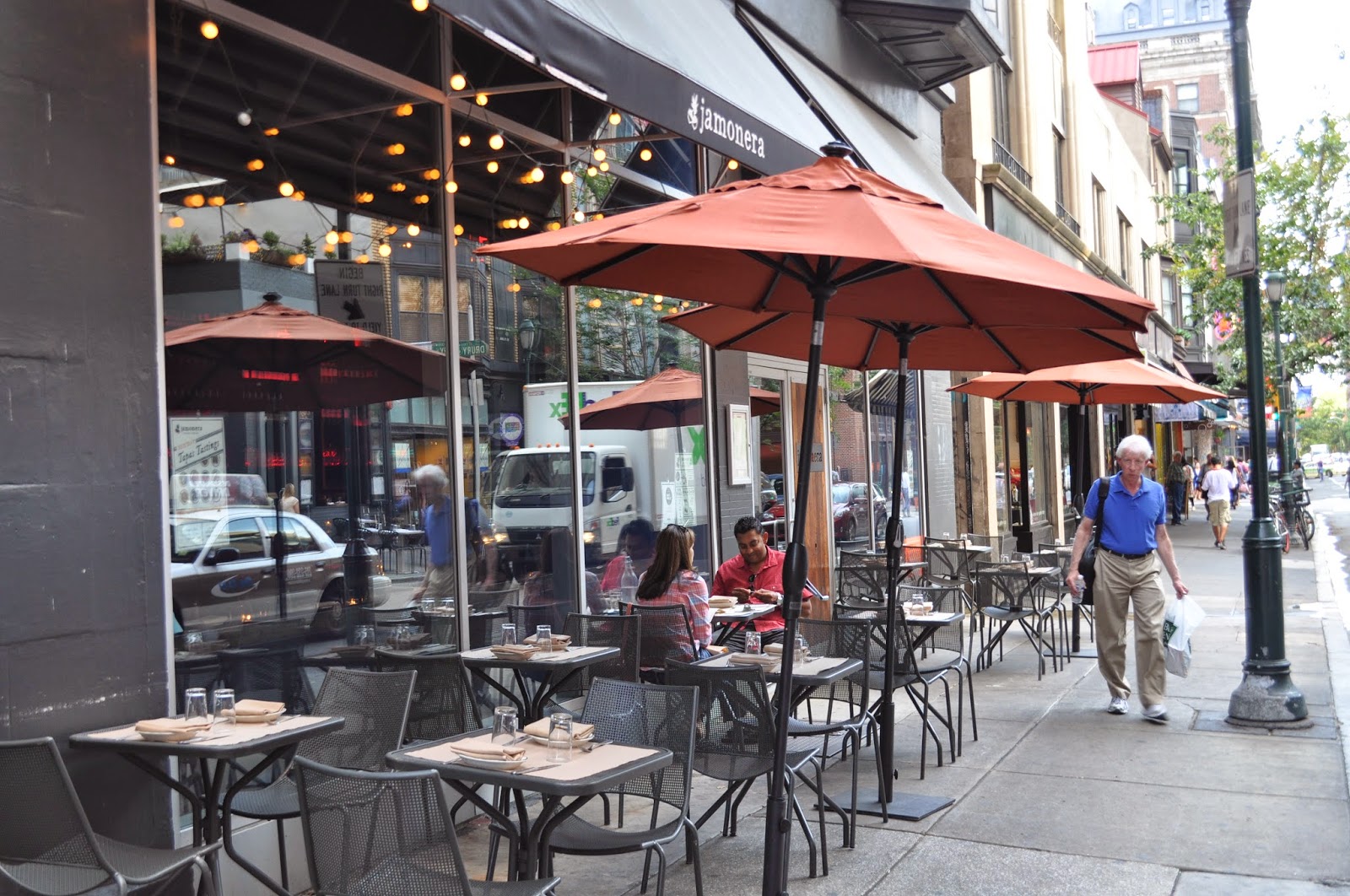
With a nice al fresco dining area, many patrons that evening chose to dine outside, but of course since I wanted shots of the restaurant exterior, I declined an outside table. And the view inside was nothing to sneeze at either:
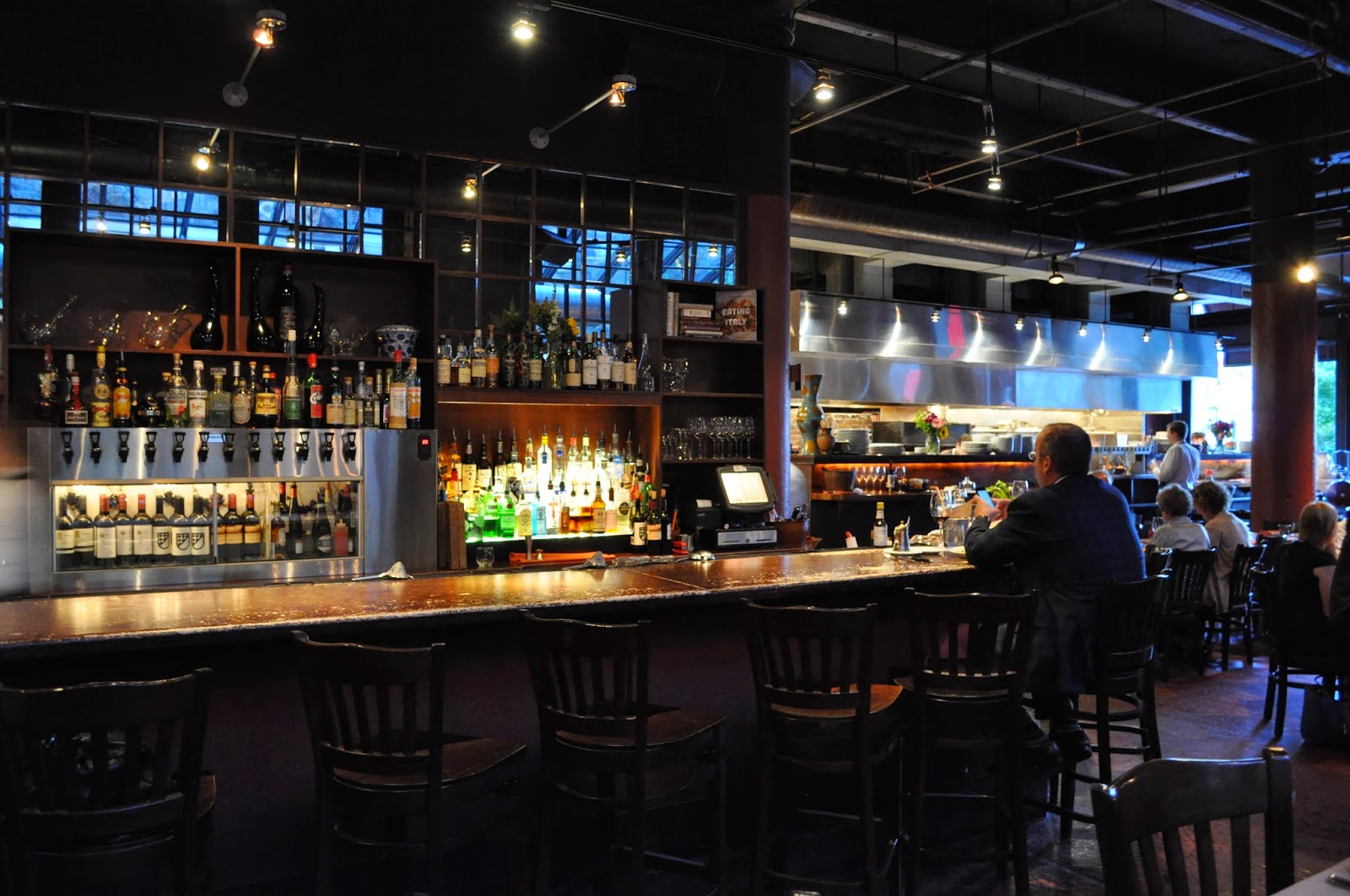
Look at that marvelous wood grating that serves as the ceiling. A well stocked bar lit by bright LEDs makes this at once a hip and modern place. A pseudo-Picasso painting adorns the wall and keeps nicely with the "red" theme of the restaurant.
A view from our table. Loved the wooden tables and chairs. Candles were a nice touch. Some diners enjoyed a dinner in the corner.
To start, I ordered this delicious gin based cocktail - La Primavera (Spanish for spring). It is composed of gin, honey, fresh lime, cardamom, and black pepper. Briefly: sweet with some spice. It was garnished nicely with a flower denoting a "spring" theme to the drink. Cardamom is of course a spice native to India with a unique flavor and aroma that is hard to put into words. It defies the boundaries of normal sensory comparisons. It is compellingly strong, yet delicate; sweet, yet powerful; with an almost eucalyptus freshness.
Food is served family style: that is, it is brought out as soon as it's ready and set in the center of the table for people to share. Hence with each course, you are given new round of small plates. With this is mind, 4-5 courses is a good, hearty portion for two at Jamonera. To start the evening, we begin with: Local Farm Salad (Gap, PA). Grilled market vegetables, whipped goat cheese, hand torn croutons, lemon-honey vinaigrette. Loved the lemon-honey vinaigrette. Absolutely delicious.
PAPA FRITA (v) 6 crispy skin potato, wood smoked garlic aioli, brava salt, house made sherry vinegar-hot sauce. It was a bit spicy but not TOO spicy. The garlic aioli was excellent (white sauce in the picture). Aioli or aïoli is a Provençal sauce made of garlic, olive oil, lemon juice, usually egg yolks, and seasonings. Brava salt is usually made from espresso. A perfect finishing salt for steaks and roasts, it can also be used in rubs and marinades or as a delicious addition to chocolates and desserts.
MUSHROOM COCA (v) 10 sautéed wild mushroom flatbread, urgelia cheese, arugula-almond pesto. Had a sweet flavor to it colored by urgelia cheese. Urgelia (also called Queso de l'Alt Urgell y la Cerdanya) is semi-soft cows milk cheese made in Alt Urgell and Cerdanay in the Catalonia region of northern Spain. The mixture of the bread, cheese and mushrooms mixed very well with the arugula pesto sauce. Arugula pesto is made with fresh arugula leaves, garlic, olive oil, walnuts, and Parmesan cheese.
BERENJENAS (v) 7 crispy eggplant fries, smoked tomato salmorejo, truffle honey, zamarano cheese. Salmorejo is a purée consisting of tomato and bread, originating from Cordoba in Andalusia, south Spain. It is made from tomatoes, bread, oil, garlic and vinegar. Normally, the tomatoes are skinned and then puréed with the other ingredients. The purée is served cold and may be garnished with diced Spanish serrano ham and diced hard-boiled eggs. Zamorano (Spanish: Queso zamorano) is a sheep's milk cheese made in the province of Zamora, Spain.
PORK TENDERLOIN 15 grilled pork, sugar plum caper chutney, seared fingerlings, arugula. The sugar plum chutney gives the pork a sweet, fruity taste which helps to sweeten the pork. Pork was tender and the fingerling potatoes balanced the meal.
ALBONDIGAS 10 manchego stuffed meatballs, serrano ham, green olive tapenade, sherry-tomato sauce, grilled baguette. Manchego is a cheese made in the La Mancha region of Spain from the milk of sheep of the manchega breed. The green olive tapenade is a greenish dipping sauce under the baguette which accompanies it quite nicely. Usually it's made with olives, garlic, capers, thyme and olive oil.
SPICED PEAR SORBET 7 rosemary-sea salt shortbread. Excellent shortbread cookies and the sorbet was very tasty as well. It was a nice excellent finish to a great meal.
Of Note:
Detail of a gorgeous ceiling chandelier.
Spotless restroom facility. However, there was only 1 bathroom that I could see (it was dark behind the curtains leading to the bathroom). Would expect a few more toilets for an entire restaurant. However, it was quite apparent the facility must have been serviced hourly because one could eat off of that toilet seat.
Some nice advertising for the sister restaurants/businesses in the Marcie Turney, Valerie Safran empire.
A saffron container serves as wall decor.
A close up of the "Picasso-esque" painting. To the left behind the curtains is the restroom.
The place settings and dining tables.
Wednesday, August 20, 2014
Tuesday, August 19, 2014
La Famiglia
La Famiglia Ristorante: Philadelphia's Best Italian Restaurant
8 S Front St, Philadelphia, PA 19106 (215) 922-2803 www.lafamiglia.com/
I lifted the title of this review from the official Google search for this restaurant, and the top of the results lists the La Famiglia website as Philadelphia's Best Italian Restaurant. A bit pompous on their part, proclaiming themselves the best, but after eating here I have to agree.
Opened in 1976, La Famiglia has been serving the Philadelphia community for almost 30 years. Given that according to the Small Business Administration, "About half of all new establishments survive five years or more and about one-third survive 10 years or more." it says something about the experience provided by dining at La Famiglia that has withstood the test of time.
Upon entering the restaurant, the establishment at once has an aristocratic, old money feel. This restaurant is not for the faint of heart, or wallet. It is also a two to three hour affair. The waitstaff doesn't even bring the menu out until 15 minutes into the meal as you are given various amuse bouches and an extensive wine list for leisure reading.
If Noah Webster made a wine dictionary, this would be it. It's no wonder La Famiglia won the Wine Spectator's Best of Award of Excellence, 2013. This wine list was thicker than a Bible or a Dictionary for that matter.
I arranged the wine list next to the flower vase at the table and salt and pepper shakers to give some sense of proportion. There are literally hundreds perhaps thousands of bottles to choose from, and given the tour of the wine cellar I took later, each and every bottle is accounted for.
The first course (complimentary) is a standard bruschetta. Excellent. Sliced tomatoes, crisp and crunchy with buttered toast perfectly browned that all melts together in your mouth. A+ One of the nice things about this restaurant is if you really like the amuse bouche you can order another round of it at no charge, which was a nice touch.
I have to take a second and comment on the china. Sterling silver cutlery and ornately decorated china make the meal so much more pleasurable. It gives a warm, family dinner style to the meal, I assume in keeping pace with the restaurant's name.
Gnocchi Gorgonzola — $16.95 Homemade gnocchi with Gorgonzola cheese, cream and crushed almonds. This was a fantastic creamy dish with a little accent by the addition of the crushed almonds. I cleaned my plate in less than 5 minutes. Delicious. For your information: Gnocchi are various thick, soft doughs that may be made from semolina, ordinary wheat flour, flour and egg, flour, egg, and cheese, potato, breadcrumbs, or similar ingredients. Usually served as a first course in place of soup.
Insalata con Arancia e Finocchio — $9.95 Mixed greens with fennel in a lemon extra virgin olive oil dressing, garnished with fresh orange slices. Also delicious, very citrusy though.
Vitello al Pistacchio — $26.95 Pistachio crusted veal medallions served with cranberry in a light madeira sauce. This was amazing. I practically licked the plate. Madeira Sauce is a classic sauce made by adding Madeira wine to a basic demi-glace (rich and deeply flavorful sauce made by half basic brown sauce and half brown stock reduction). The Madeira sauce is an excellent accompaniment for roasts and steaks.
Special: Veal wrapped with Italian eggplant. Finished with a touch of eggplant cream sauce. Eggplant and veal certainly is an interesting mixture. It was not bad by any means but certainly not a combination I would make myself. The veal was tender and sauce was adequate and creamy. Nothing too crazy here.
For dessert: Creme caramel, vanilla flavored flan. Interestingly enough, this is a dessert of Spanish origin so I was surprised to find it on the Italian restaurant dessert menu. It was very good and the caramel sauce was fantastic. Presentation was a bit on the plain side, but it certainly made up for it in taste.
Of note:
A fully stocked bar adjacent to the main dining area.
Bottles of fine spirits adorn the mantles.
Gorgeous overhead lights
This is a view of the wine cellar with hundreds and hundreds of bottles of wine. I am standing just outside the restroom facing the beginning of the wine cellar. Some bottles are visible in the far right of the above picture.
Inside the bathroom. Marble and ornate decor everywhere. Certainly one of the best restaurant bathrooms in my opinion.
Look at all that tile and marble.
A detail showcasing the wine cellar. Chairs are set up along the walls so one can enjoy a glass or two admiring the general splendor of the area.
History of the Restaurant (Per La Famiglia Website)
The Sena family tradition of culinary excellence dates back to early 1947 when Carlo "Papa" Sena began to cook in postwar Naples. The family carried this experience across the Atlantic and opened La Famiglia in 1976 in the shell of a Colonial tea warehouse. With the help of his family, and a lot of hard work and dedication, Carlo turned La Famiglia into one of Philadelphia's top culinary institutions. Since their father retired from the kitchen in the early nineties, Carlo's two sons, Giuseppe and Gino have maintained the first-class image of La Famiglia that its long-time patrons recall from the early days. Those who consider themselves to be La Famiglia loyalists can still find that same level of service. Today, La Famiglia stands as the finest Italian restaurant in Philadelphia and a major landmark on the city's vibrant dining scene. It has earned an international reputation as one of the finest examples of gourmet Italian cuisine to be served outside of Italy.
8 S Front St, Philadelphia, PA 19106 (215) 922-2803 www.lafamiglia.com/
I lifted the title of this review from the official Google search for this restaurant, and the top of the results lists the La Famiglia website as Philadelphia's Best Italian Restaurant. A bit pompous on their part, proclaiming themselves the best, but after eating here I have to agree.
Opened in 1976, La Famiglia has been serving the Philadelphia community for almost 30 years. Given that according to the Small Business Administration, "About half of all new establishments survive five years or more and about one-third survive 10 years or more." it says something about the experience provided by dining at La Famiglia that has withstood the test of time.
Upon entering the restaurant, the establishment at once has an aristocratic, old money feel. This restaurant is not for the faint of heart, or wallet. It is also a two to three hour affair. The waitstaff doesn't even bring the menu out until 15 minutes into the meal as you are given various amuse bouches and an extensive wine list for leisure reading.
If Noah Webster made a wine dictionary, this would be it. It's no wonder La Famiglia won the Wine Spectator's Best of Award of Excellence, 2013. This wine list was thicker than a Bible or a Dictionary for that matter.
I arranged the wine list next to the flower vase at the table and salt and pepper shakers to give some sense of proportion. There are literally hundreds perhaps thousands of bottles to choose from, and given the tour of the wine cellar I took later, each and every bottle is accounted for.
The first course (complimentary) is a standard bruschetta. Excellent. Sliced tomatoes, crisp and crunchy with buttered toast perfectly browned that all melts together in your mouth. A+ One of the nice things about this restaurant is if you really like the amuse bouche you can order another round of it at no charge, which was a nice touch.
I have to take a second and comment on the china. Sterling silver cutlery and ornately decorated china make the meal so much more pleasurable. It gives a warm, family dinner style to the meal, I assume in keeping pace with the restaurant's name.
Gnocchi Gorgonzola — $16.95 Homemade gnocchi with Gorgonzola cheese, cream and crushed almonds. This was a fantastic creamy dish with a little accent by the addition of the crushed almonds. I cleaned my plate in less than 5 minutes. Delicious. For your information: Gnocchi are various thick, soft doughs that may be made from semolina, ordinary wheat flour, flour and egg, flour, egg, and cheese, potato, breadcrumbs, or similar ingredients. Usually served as a first course in place of soup.
Insalata con Arancia e Finocchio — $9.95 Mixed greens with fennel in a lemon extra virgin olive oil dressing, garnished with fresh orange slices. Also delicious, very citrusy though.
Vitello al Pistacchio — $26.95 Pistachio crusted veal medallions served with cranberry in a light madeira sauce. This was amazing. I practically licked the plate. Madeira Sauce is a classic sauce made by adding Madeira wine to a basic demi-glace (rich and deeply flavorful sauce made by half basic brown sauce and half brown stock reduction). The Madeira sauce is an excellent accompaniment for roasts and steaks.
Special: Veal wrapped with Italian eggplant. Finished with a touch of eggplant cream sauce. Eggplant and veal certainly is an interesting mixture. It was not bad by any means but certainly not a combination I would make myself. The veal was tender and sauce was adequate and creamy. Nothing too crazy here.
For dessert: Creme caramel, vanilla flavored flan. Interestingly enough, this is a dessert of Spanish origin so I was surprised to find it on the Italian restaurant dessert menu. It was very good and the caramel sauce was fantastic. Presentation was a bit on the plain side, but it certainly made up for it in taste.
Of note:
A fully stocked bar adjacent to the main dining area.
Bottles of fine spirits adorn the mantles.
Gorgeous overhead lights
This is a view of the wine cellar with hundreds and hundreds of bottles of wine. I am standing just outside the restroom facing the beginning of the wine cellar. Some bottles are visible in the far right of the above picture.
Inside the bathroom. Marble and ornate decor everywhere. Certainly one of the best restaurant bathrooms in my opinion.
Look at all that tile and marble.
A detail showcasing the wine cellar. Chairs are set up along the walls so one can enjoy a glass or two admiring the general splendor of the area.
History of the Restaurant (Per La Famiglia Website)
The Sena family tradition of culinary excellence dates back to early 1947 when Carlo "Papa" Sena began to cook in postwar Naples. The family carried this experience across the Atlantic and opened La Famiglia in 1976 in the shell of a Colonial tea warehouse. With the help of his family, and a lot of hard work and dedication, Carlo turned La Famiglia into one of Philadelphia's top culinary institutions. Since their father retired from the kitchen in the early nineties, Carlo's two sons, Giuseppe and Gino have maintained the first-class image of La Famiglia that its long-time patrons recall from the early days. Those who consider themselves to be La Famiglia loyalists can still find that same level of service. Today, La Famiglia stands as the finest Italian restaurant in Philadelphia and a major landmark on the city's vibrant dining scene. It has earned an international reputation as one of the finest examples of gourmet Italian cuisine to be served outside of Italy.
Osteria
Osteria
640 N Broad St, Philadelphia, PA 19130 (215) 763-0920
I give you, Osteria. A seasonal Italian menu permeates the rustic feel of this place with a huge beautiful wood brick oven centered open kitchen serving up homemade pizzas as the centerpiece. This is the second restaurant in the famous Vetri family of restaurants after of course Vetri, which I have also reviewed here.
Osteria opened in 2007 and has since become one of the East Coast's most famous Italian restaurants garnering much critical acclaim. Chefs Marc Vetri and Jeff Michaud certainly do the restaurant justice. An osteria in Italy was originally a place serving wine and simple food. Lately, the emphasis has shifted to the food, but menus tend to be short, with an emphasis on local specialties such as pasta, grilled meat or fish, and often served at shared tables. Ideal for a cheap lunch, osterie (the plural in Italian) also cater for after work and evening refreshment. Osterie vary greatly in practice: some only serve drinks and clients are allowed to bring in their own food; some have retained a predominantly male clientele whilst others have reached out to students and young professionals.
Very appropriately, the restaurant signage incorporates a bottle of wine in the process of being uncorked to suggest the Italian origins of the name.
Simple flowers decorate the wooden tables to give the restaurant a rustic feel in keeping with a traditional osteria theme.
A spacious dining area with open air vistas onto the patio and an enclosed glass seating area give one the feeling he is outside in an open air market.
The meal begins with a mix of breads, the most notable being some cheese-bread sticks laid on the top of the various housemade breads. Of course, olive oil accompanies the bread.
I would be remiss if I did not mention this cocktail. It was one of the best I've had this summer. Osteria makes their own limoncello to give their Sicilian Lemonade the most delicious flavor.
Sicilian Lemonade: house made limoncello, fresh mint, lime.
Limoncello is made from lemon zest, or peels without the pith, steeped in rectified spirit (pure ethyl alcohol 95% ABV) until the oil is released. The resulting yellow liquid is then mixed with simple syrup. Varying sugar to water ratio and temperature will affect the clarity, viscosity, and flavor.
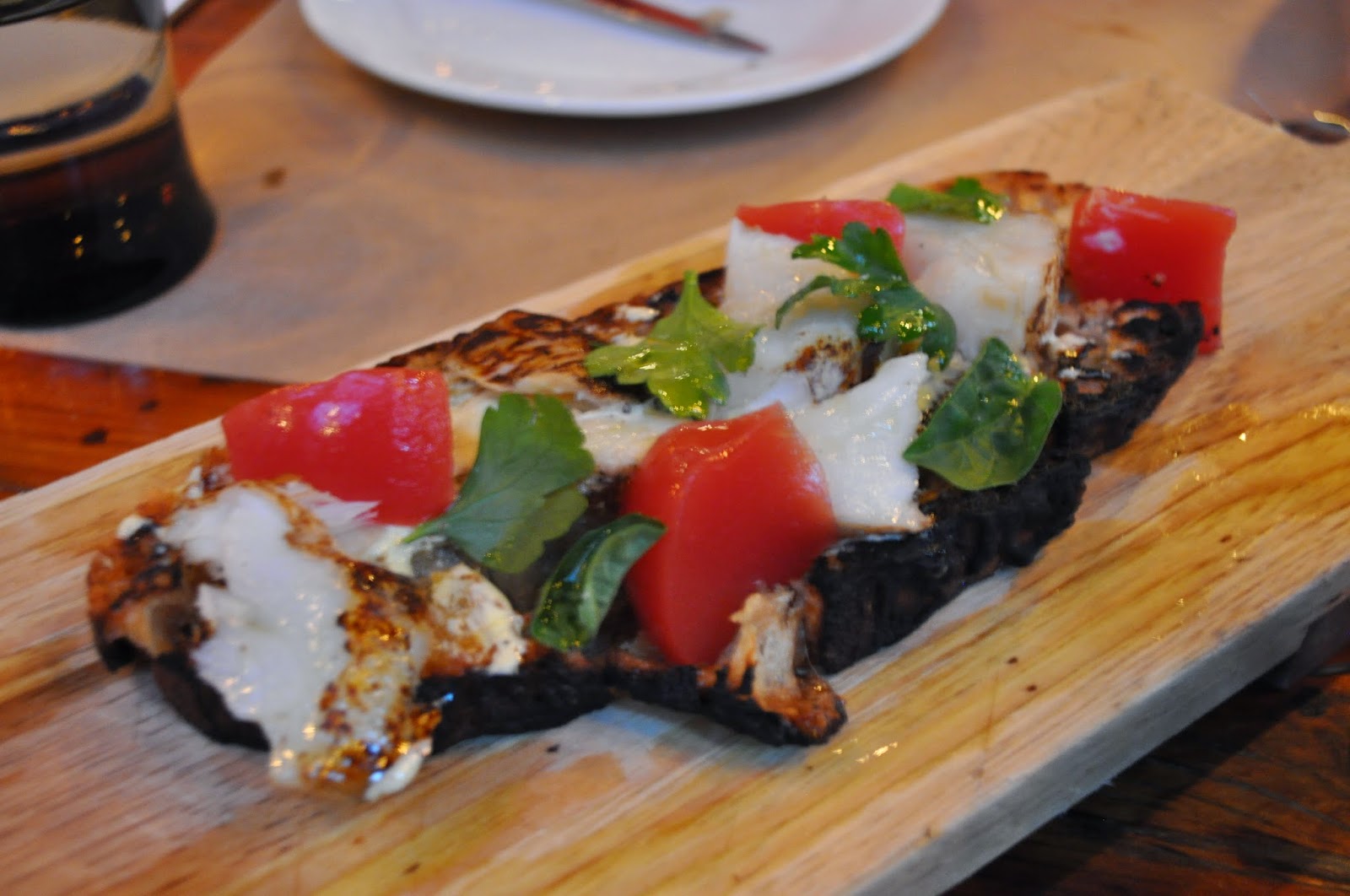
To start the meal off we chose the special: Osteria's take on a classic Italian dish: the bruschetta. It was not quite as amazing as I had hoped given the hype over this restaurant. However, I was already on my second mouth-watering Sicilian Lemonade, so I didn't really pay too much attention to this obvious faux pas. The bread was a little too charred for my taste and the tomatoes were either soaked in juice or were just saturated too long because they were literally the consistency of an over-ripened peach. They didn't taste bad by any means, but I'm used to a little more crunch to my tomatoes. This is of course personal preference talking here as I'm sure others would love some squishy tomatoes but I like a little crunch in my bunch of veggies.
Next up, in my quest for being a culinary-adventurer, I decided on the grilled veal sweetbread spiedini with stonefruits and pine nuts. The term "spiedie" comes from the Italian spiedo meaning spit or spiedini referring to cubes or balls of meat cooked on a skewer. Hence we are able to see the sweetbread (spiedini) served on a skewer (spiedo). Sweetbread of course refers to thymus (also called throat, gullet, or neck sweetbread) or the pancreas (also called heart, stomach, or belly sweetbread), especially of the calf (ris de veau) and lamb (ris d'agneau), and less commonly of beef and pork. Since veal is generally produced from young male calves, I'm assuming I was eating pancreas, but it is of course impossible to tell. The sweetbread itself is very chewy and largely tasteless which is balanced by the sweetness of the stonefruit and pine nuts. The pine nuts are the small yellow seeds visible while the stone fruit are the orange fruits surrounding the skewer.
My dinner companion's mozzarella cheese balls with tomato sauce was decidedly better than the sweetbread.
Not much to say here. They were competently prepared, in my opinion, presentation was a bit lacking, but overall, tasted good.
Grilled wild Alaskan king salmon with zucchini, herb oil and salmon terrine. Terrine is a French forcemeat (mixture of ground, lean meat emulsified with fat) loaf similar to a pâté, made with more coarsely chopped ingredients. So in this dish, the terrine would be the pink half circle wrapped in the zucchini skin. The salmon itself was a bit raw for my taste. I like the fish to be pink (medium preparation) while this salmon seemed at any moment ready to swim off my plate. I also prefer the salmon to be descaled , but that is personal preference. It wasn't bad, but as my friend would say, "I was eating it because it was there." He also commented that it looked a bit raw to him as well.
While my batting average of the evening stood at 0-2, this was decidedly the redeeming deus ex machina of this culinary performance. This was the smoked creekstone farm brisket with peach and radicchio. The bitter, spicy taste of the purplish radicchio was balanced by the sweetness of the peaches. A true ambrosia. The brisket was tender and sweet--a true feat considering its origins. Brisket is a cut of meat from the breast or lower chest of beef or veal. The beef brisket is one of the nine beef primal cuts, though the precise definition of the cut differs internationally. The brisket muscles include the superficial and deep pectorals. As cattle do not have collar bones, these muscles support about 60% of the body weight of standing/moving cattle. This requires a significant amount of connective tissue, so the resulting meat must be cooked correctly to tenderize the connective tissue. This was hands down the best dish of the evening and any foodie should get the brisket. It will be a boisterous uproar I predict when this specimen is taken off the menu.
Although already stuffed, gluttony is one of the chief virtues of any food critic. And I would chastise myself later if I passed up a raspberry and pistachio linzertorte with lemon verbena gelato. Wouldn't you? Dessert was no doubt delicious but I was so stuffed at this point it made hardly any difference. It is difficult to do anything bad when you mix raspberries and pistachio. Of note, the Linzer Torte (or Linzertorte) is an Austrian torte with a lattice design on top of the pastry. It is hard to see due to the confectionary sugar, but it is present. Lemon verbana is a leafy plant that adds a fresh, lemon flavor to any dish, in this case, the gelato.
In Other News:
High ceilings cast a nice glow and ambiance to the restaurant.
A private dining area seats 50 for parties or special events.
Bathrooms are clean and nicely furnished.
A gorgeous glass-enclosed patio lets diners enjoy a natural lit dining experience.
The open bar and kitchen area gives restaurant patrons a sense of honesty in the food being crafted.
A lighting detail featured on the high ceilings.
Featured on a wall panel:
La vita è troppo breve per bere vino cattivo. Life's too short to drink bad/cheap wine.
The bar area, detail.
640 N Broad St, Philadelphia, PA 19130 (215) 763-0920
Osteria opened in 2007 and has since become one of the East Coast's most famous Italian restaurants garnering much critical acclaim. Chefs Marc Vetri and Jeff Michaud certainly do the restaurant justice. An osteria in Italy was originally a place serving wine and simple food. Lately, the emphasis has shifted to the food, but menus tend to be short, with an emphasis on local specialties such as pasta, grilled meat or fish, and often served at shared tables. Ideal for a cheap lunch, osterie (the plural in Italian) also cater for after work and evening refreshment. Osterie vary greatly in practice: some only serve drinks and clients are allowed to bring in their own food; some have retained a predominantly male clientele whilst others have reached out to students and young professionals.
Very appropriately, the restaurant signage incorporates a bottle of wine in the process of being uncorked to suggest the Italian origins of the name.
Simple flowers decorate the wooden tables to give the restaurant a rustic feel in keeping with a traditional osteria theme.
A spacious dining area with open air vistas onto the patio and an enclosed glass seating area give one the feeling he is outside in an open air market.
I would be remiss if I did not mention this cocktail. It was one of the best I've had this summer. Osteria makes their own limoncello to give their Sicilian Lemonade the most delicious flavor.
Sicilian Lemonade: house made limoncello, fresh mint, lime.
Limoncello is made from lemon zest, or peels without the pith, steeped in rectified spirit (pure ethyl alcohol 95% ABV) until the oil is released. The resulting yellow liquid is then mixed with simple syrup. Varying sugar to water ratio and temperature will affect the clarity, viscosity, and flavor.
To start the meal off we chose the special: Osteria's take on a classic Italian dish: the bruschetta. It was not quite as amazing as I had hoped given the hype over this restaurant. However, I was already on my second mouth-watering Sicilian Lemonade, so I didn't really pay too much attention to this obvious faux pas. The bread was a little too charred for my taste and the tomatoes were either soaked in juice or were just saturated too long because they were literally the consistency of an over-ripened peach. They didn't taste bad by any means, but I'm used to a little more crunch to my tomatoes. This is of course personal preference talking here as I'm sure others would love some squishy tomatoes but I like a little crunch in my bunch of veggies.
Next up, in my quest for being a culinary-adventurer, I decided on the grilled veal sweetbread spiedini with stonefruits and pine nuts. The term "spiedie" comes from the Italian spiedo meaning spit or spiedini referring to cubes or balls of meat cooked on a skewer. Hence we are able to see the sweetbread (spiedini) served on a skewer (spiedo). Sweetbread of course refers to thymus (also called throat, gullet, or neck sweetbread) or the pancreas (also called heart, stomach, or belly sweetbread), especially of the calf (ris de veau) and lamb (ris d'agneau), and less commonly of beef and pork. Since veal is generally produced from young male calves, I'm assuming I was eating pancreas, but it is of course impossible to tell. The sweetbread itself is very chewy and largely tasteless which is balanced by the sweetness of the stonefruit and pine nuts. The pine nuts are the small yellow seeds visible while the stone fruit are the orange fruits surrounding the skewer.
My dinner companion's mozzarella cheese balls with tomato sauce was decidedly better than the sweetbread.
Not much to say here. They were competently prepared, in my opinion, presentation was a bit lacking, but overall, tasted good.
Grilled wild Alaskan king salmon with zucchini, herb oil and salmon terrine. Terrine is a French forcemeat (mixture of ground, lean meat emulsified with fat) loaf similar to a pâté, made with more coarsely chopped ingredients. So in this dish, the terrine would be the pink half circle wrapped in the zucchini skin. The salmon itself was a bit raw for my taste. I like the fish to be pink (medium preparation) while this salmon seemed at any moment ready to swim off my plate. I also prefer the salmon to be descaled , but that is personal preference. It wasn't bad, but as my friend would say, "I was eating it because it was there." He also commented that it looked a bit raw to him as well.
While my batting average of the evening stood at 0-2, this was decidedly the redeeming deus ex machina of this culinary performance. This was the smoked creekstone farm brisket with peach and radicchio. The bitter, spicy taste of the purplish radicchio was balanced by the sweetness of the peaches. A true ambrosia. The brisket was tender and sweet--a true feat considering its origins. Brisket is a cut of meat from the breast or lower chest of beef or veal. The beef brisket is one of the nine beef primal cuts, though the precise definition of the cut differs internationally. The brisket muscles include the superficial and deep pectorals. As cattle do not have collar bones, these muscles support about 60% of the body weight of standing/moving cattle. This requires a significant amount of connective tissue, so the resulting meat must be cooked correctly to tenderize the connective tissue. This was hands down the best dish of the evening and any foodie should get the brisket. It will be a boisterous uproar I predict when this specimen is taken off the menu.
Although already stuffed, gluttony is one of the chief virtues of any food critic. And I would chastise myself later if I passed up a raspberry and pistachio linzertorte with lemon verbena gelato. Wouldn't you? Dessert was no doubt delicious but I was so stuffed at this point it made hardly any difference. It is difficult to do anything bad when you mix raspberries and pistachio. Of note, the Linzer Torte (or Linzertorte) is an Austrian torte with a lattice design on top of the pastry. It is hard to see due to the confectionary sugar, but it is present. Lemon verbana is a leafy plant that adds a fresh, lemon flavor to any dish, in this case, the gelato.
In Other News:
High ceilings cast a nice glow and ambiance to the restaurant.
A private dining area seats 50 for parties or special events.
Bathrooms are clean and nicely furnished.
A gorgeous glass-enclosed patio lets diners enjoy a natural lit dining experience.
The open bar and kitchen area gives restaurant patrons a sense of honesty in the food being crafted.
A lighting detail featured on the high ceilings.
Featured on a wall panel:
La vita è troppo breve per bere vino cattivo. Life's too short to drink bad/cheap wine.
The bar area, detail.
Subscribe to:
Posts (Atom)